An AI demo can be impressive. A customer asks a question, the system understands the request, retrieves useful information and produces a convincing response. Connect that AI to a business application, and it may even perform an action.
An appointment gets rescheduled. A customer record gets updated. A support request gets assigned. At least, that is what the AI reports.
But how do we know the work actually happened?
That question matters when AI moves beyond generating information and starts changing real business systems. A convincing response may demonstrate that the model understood the task. It does not necessarily prove that the intended business outcome occurred.
The transition from demo to production requires a different standard of success: the system needs appropriate evidence of what actually changed.
A working demo and a dependable system answer different questions
During prototyping, teams naturally focus on capability. Can the model understand the request, retrieve relevant context, choose a tool and produce a useful answer? Those are important feasibility tests.
Now imagine a customer asks, “Can you move my appointment from Thursday to Friday?”
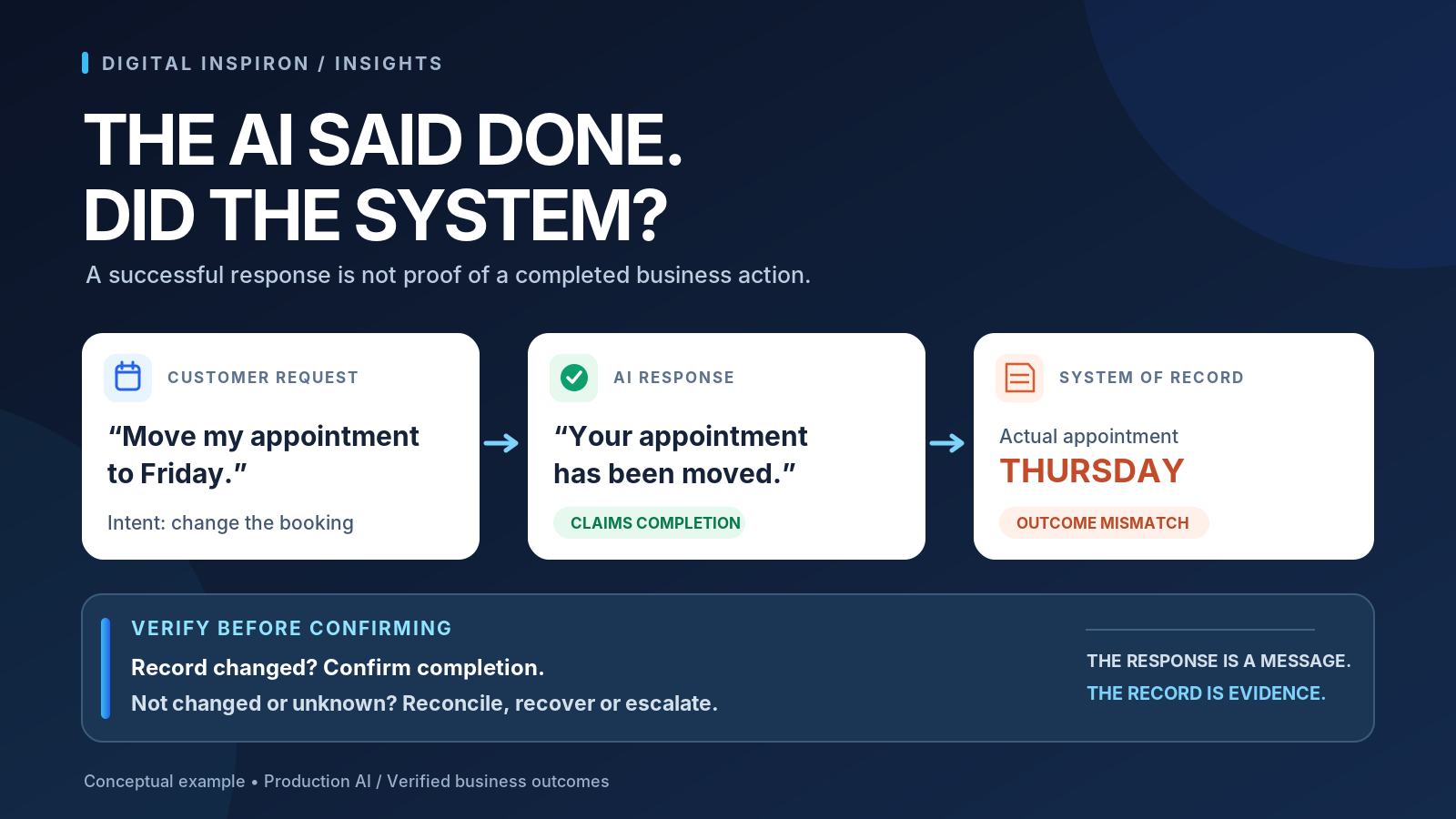
The AI identifies the booking, calls a scheduling function and replies, “Your appointment has been moved to Friday.” From the customer's perspective, the work is complete.
But the underlying service might have rejected the change. The system could have selected the wrong appointment. A request might have been accepted for processing without the booking actually changing. The customer-facing sentence alone cannot distinguish those outcomes.
Production asks whether the entire workflow produced the correct business result, not merely whether the AI produced the expected response.
1. Define what completion means before the AI takes action
For an appointment change, a successful outcome may require the correct customer's booking to be identified, the change to be authorized, the new slot to be available and the authoritative booking record to reflect the approved request.
These are business conditions, not linguistic ones. The model may be excellent at describing a completed action while the operation remains pending or unsuccessful.
Tool success is a technical event. Task completion is a business outcome.
An API acknowledgement may mean only that a request was received. A successful tool invocation may not establish that all downstream steps completed. And a fluent confirmation is not an independent verification signal.
Arize's agent-reliability guidance describes false completion as an agent reporting success without valid outcome evidence. The operational implication is that completion criteria should come from the business workflow, not from the model's confidence in its final message.
2. Correct outcomes depend on correct business context
A model can interpret the customer's request correctly and still act on the wrong information.
Perhaps the customer has two appointments. Perhaps the booking was changed by a staff member moments earlier. Perhaps the system retrieved stale availability or failed to identify which record was authoritative.
The application must establish what information belongs to the current request, what the current state is and when it needs to be refreshed. For action-taking AI, context is not simply material that makes an answer more relevant. It can determine whether an action is correct.
Google Cloud's production-agent guidance treats context, state, orchestration and security as concerns beyond a working prototype.
A stronger model cannot reliably compensate for incorrect business state.
3. Tool access does not establish permission
A scheduling API may allow an appointment to be changed. That does not mean the AI should be permitted to change every appointment under every circumstance.
The business may require customer confirmation, enforce a cancellation window or reserve certain changes for staff approval. Those conditions should be checked by the application, rather than depending solely on the model to remember and obey a written instruction.
The useful distinction is between an action the AI can propose and an action the system will authorize.
This matters especially when an agent interacts with payments, account permissions, customer records or other operations with consequences outside the conversation.
4. Verify the outcome before confirming completion
Suppose the AI submits the rescheduling request and the external system acknowledges it. What should happen next?
The answer depends on the integration. The application might read back the authoritative record, inspect a confirmed operation result or reconcile an asynchronous status update. Not every workflow needs the same verification mechanism, but important actions need evidence appropriate to their consequences.
If the booking has changed as intended, the system can confirm completion. If the change is pending, the response should say so. If the result is uncertain, the system should not invent certainty. If it failed, the workflow needs to determine the next safe step.
For the customer, “Your appointment has been moved” is a message. The updated booking is the evidence.
This distinction is also relevant to testing. LangChain's agent-evaluation guidance separates final-response quality, execution trajectory and resulting state changes. A correct sentence can coexist with an incorrect side effect.
The system of record, not the AI's confirmation, determines whether operational work is complete.
5. When the result is wrong, the execution path matters
Even a carefully designed workflow can fail. When it does, a team needs to know what happened.
Which booking did the system retrieve? What context was available? Which action did the AI select? What parameters reached the tool? What did the integration return? Was the result checked before the customer was told it was complete?
A final chat message rarely answers those questions. Traces and relevant operational records can help reconstruct the execution path, investigate a failure and improve the system. That evidence should be collected with appropriate security, privacy and retention controls, not by indiscriminately storing sensitive customer information.
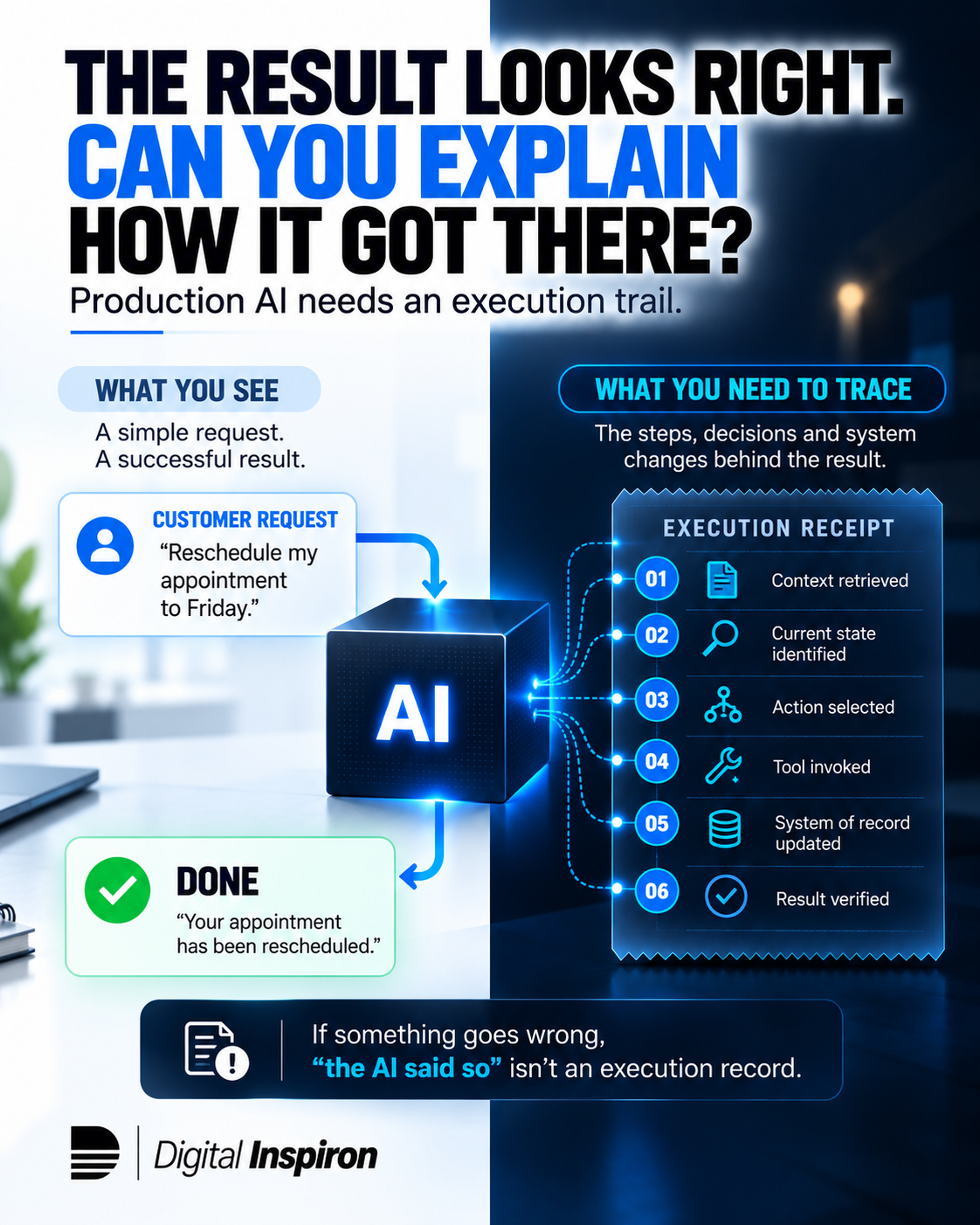
Traceability is not the end goal. It is what makes the system supportable when the outcome is unexpected.
6. Design for uncertain and partial outcomes
A tool can time out after receiving a request. An action may have partially completed. An external system may return an ambiguous status. Blindly repeating the call can create duplicate bookings, messages or financial transactions.
The application may first need to determine whether the original operation took effect. Depending on the workflow, it may then retry safely, reconcile the state, ask for clarification, stop or escalate.
Arize's harness-engineering guidance describes why authority, completion evidence and recovery from ambiguous side effects need runtime controls rather than model assurances alone.
A dependable workflow needs a designed path for the times when success cannot yet be established.
7. Human intervention should preserve the work already done
Some requests should reach a person. That can be the correct outcome when information is missing, the requested action exceeds the AI's authority or the result cannot be safely resolved.
But a useful handoff transfers more than “AI couldn't complete the task.” It should preserve enough relevant context to show what the customer wanted, what the system attempted, what state is known and which decision remains.
Human intervention is most effective when it continues the workflow instead of forcing everyone to restart it.
A practical production AI check
Before letting AI perform operational work, ask whether the workflow can answer these questions:
-
Context
Does the system have the correct information and current business state?
-
Authority
Is the requested action permitted under these conditions?
-
Execution
Can the underlying application perform the operation?
-
Verification
What evidence establishes that the intended outcome occurred?
-
Traceability
Can the team reconstruct important decisions and actions?
-
Recovery
What happens when the result is failed, partial or uncertain?
-
Handoff
Can a person continue with the necessary context?
This is not a complete substitute for security testing, model evaluation, infrastructure monitoring or release management. It is a practical way to review one dimension of production readiness: can the business trust the result of the whole workflow?
Controls should match the consequences. An AI assistant summarizing internal notes does not need the same operational safeguards as an agent changing payment records. The aim is appropriate engineering, not unnecessary complexity.
From convincing responses to dependable outcomes
A successful AI demo demonstrates capability. That is valuable, but once AI starts changing business systems, capability is only part of the problem.
The surrounding application must provide the right context, enforce authority, execute permitted actions, verify important outcomes, preserve useful evidence and handle situations where the work cannot safely finish.
The final response still matters because it is how the customer understands what happened. But it should reflect the actual state of the work, not replace evidence of completion.
The AI saying “done” is not proof that the work is done.