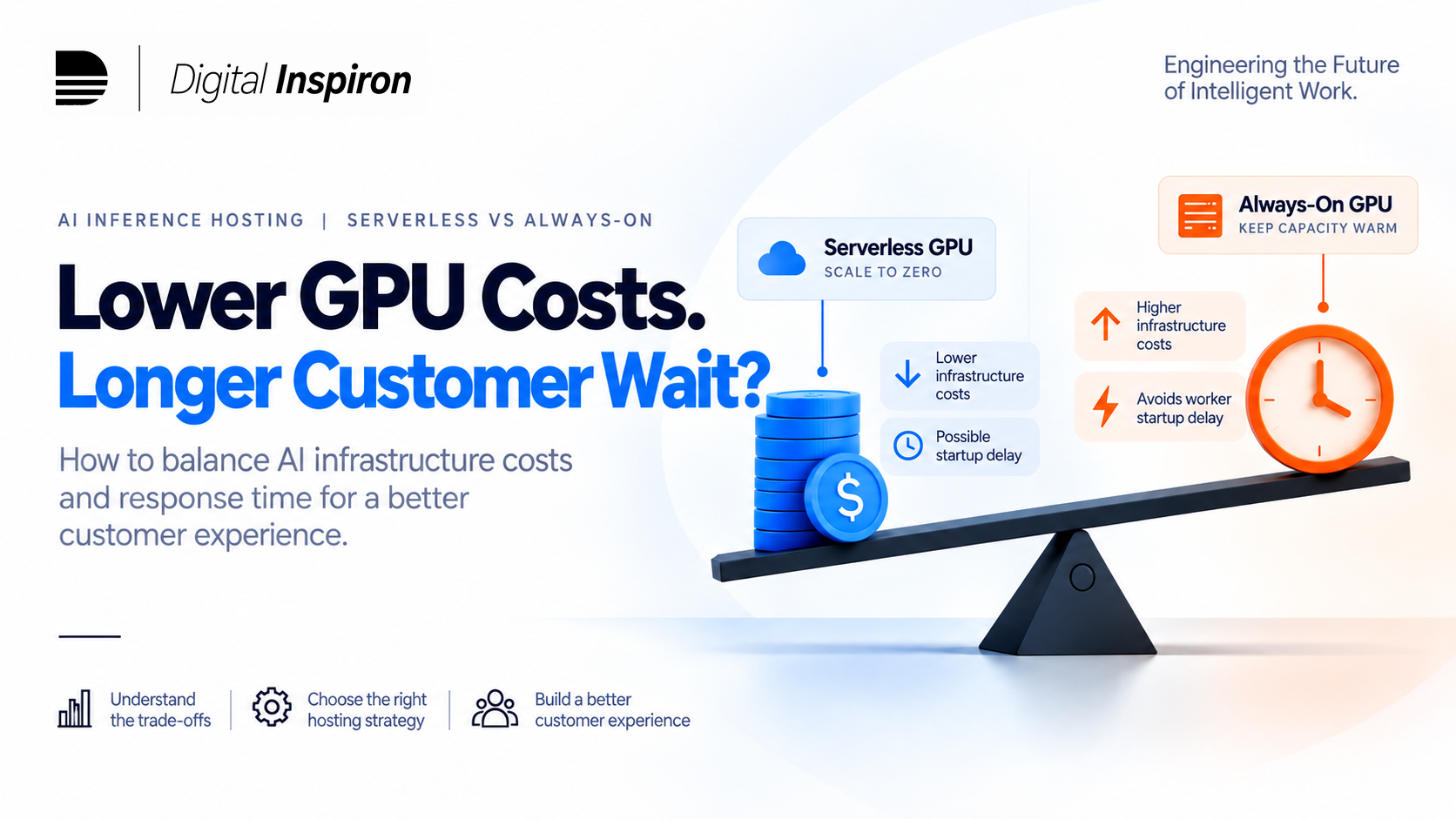
Your AI hosting bill is lower. But are your customers waiting longer?
Consider a SaaS application with an AI assistant.
The assistant performs well during testing. It answers questions, processes requests and produces useful responses.
To reduce infrastructure spending, the engineering team configures its GPU workers to shut down when the application is idle.
That can be a sensible decision. Why keep paying for computing capacity nobody is using?
But the next customer request may arrive when no inference worker is ready.
Before the model can respond, the infrastructure might need to start a worker, initialize its runtime and load the model.
The company has reduced its idle infrastructure expense. It may also have introduced additional waiting time into the customer experience.
That is the real decision behind serverless versus always-on GPU hosting.
The objective is not simply to find the lowest GPU price. It is to balance infrastructure cost with the response time the application needs to deliver.
Serverless vs dedicated GPU: The short answer
Serverless GPU hosting can suit applications with intermittent or unpredictable demand. Depending on the configuration, workers can scale down when idle, reducing the cost of keeping unused compute available.
Dedicated, always-on GPU hosting can be appropriate when an application needs continuously available inference capacity or has enough sustained demand to justify it.
A third option is to maintain a smaller amount of warm capacity while allowing additional workers to scale when demand increases.
There is an important distinction here.
Serverless describes how infrastructure is provided and managed. Always-on describes whether capacity remains available.
Some serverless platforms support continuously running workers. Dedicated GPU instances can also be stopped or scaled through other infrastructure controls.
The practical comparison is therefore between operating configurations, not two completely separate categories of technology.
Why an AI application may respond slowly after being idle
An AI application needs more than an available GPU.
The inference environment must be ready to accept requests.
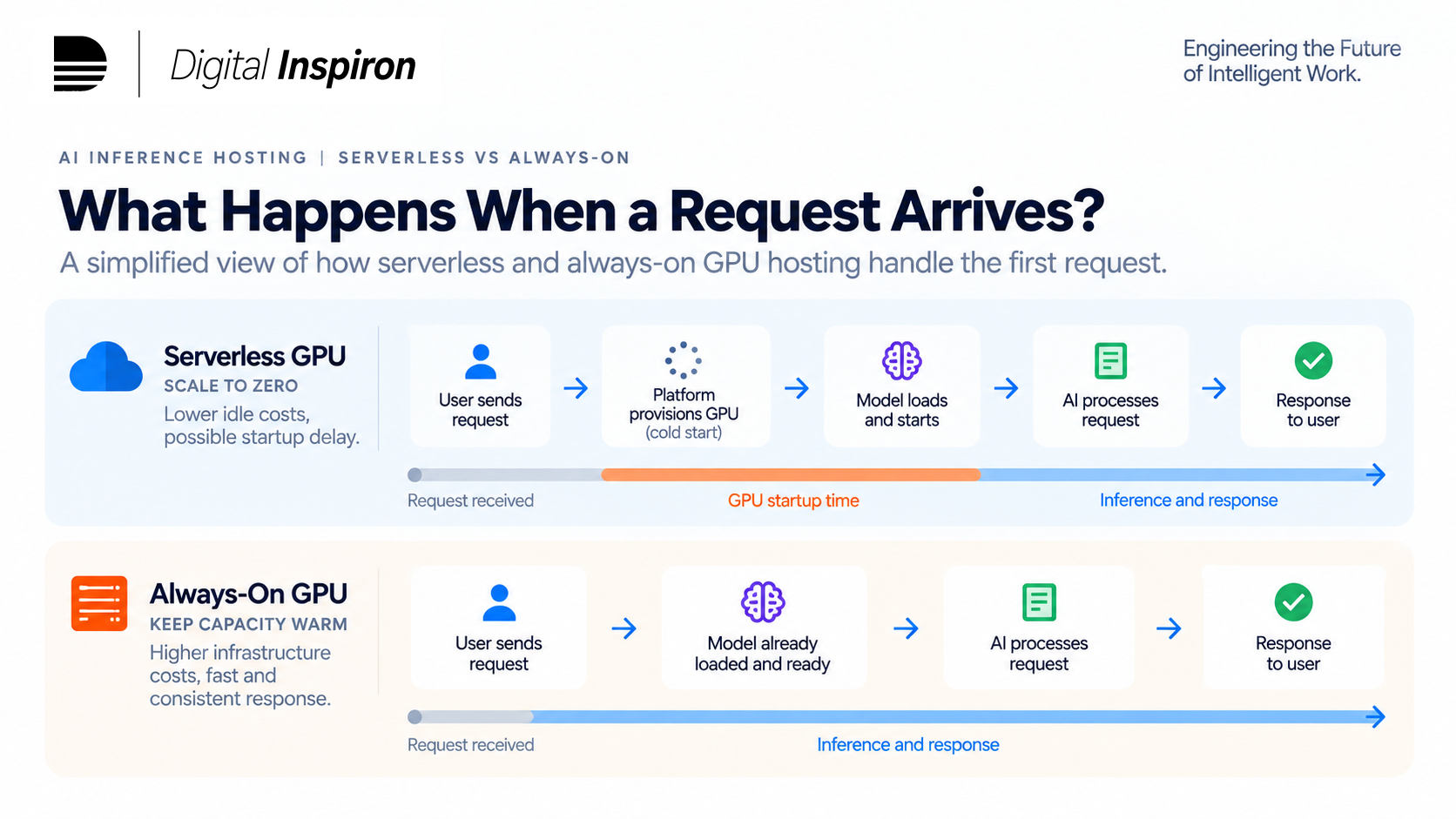
When a request must wait for an inference worker to become ready, the additional initialization process is commonly described as a cold start.
The delay may include provisioning, container startup, runtime initialization and model loading, depending on the platform.
Consider two possible request paths.
When capacity is ready:
Customer request → Ready worker → Model processing → Response
When capacity has scaled to zero:
Customer request → Worker startup → Model initialization → Model processing → Response
The second path contains additional preparation before inference can begin.
How much time that preparation takes depends on the provider, model, hardware, caching configuration and deployment architecture.
It should be measured rather than assumed.
Cold starts are also only one possible source of latency.
A slow response may involve request queueing, network delays, long prompts, retrieval operations, model processing or downstream services.
Keeping a worker warm can address startup delays. It does not automatically solve every performance problem.
The real cost includes infrastructure and waiting time
GPU hosting costs are relatively straightforward to compare.
Providers publish rates, billing rules and resource configurations.
Customer waiting time is more difficult to evaluate.
A team cannot automatically assume that a particular delay causes a particular amount of lost revenue. That would require evidence from the actual product and its users.
But response time still belongs in the infrastructure decision.
Consider two different AI workloads.
An asynchronous document-processing application may allow someone to submit a file and return later for the result.
A live customer-support assistant has a different interaction pattern. The person asking a question may expect the conversation to begin promptly.
Both applications could use the same underlying model.
Their infrastructure requirements may be very different.
The infrastructure decision is also part of a broader AI application design, where model capabilities, integration requirements and the customer experience need to work together.
The useful question is not only:
How much does this GPU cost per hour?
It is:
What response time does this workflow need, and what does it cost to provide that experience reliably?
That question provides a better starting point for architecture decisions.
When scale-to-zero serverless hosting makes sense
Scale-to-zero hosting deserves consideration when demand is intermittent, unpredictable or concentrated into short periods.
Potential examples include occasional internal AI tasks, experimental applications and background-processing workloads.
The main advantage is the ability to avoid maintaining the same amount of GPU capacity throughout every idle period.
However, usage-based billing does not necessarily mean paying only while the model is generating output.
Depending on the provider, charges may include worker startup, request execution and configured idle periods. Storage and other supporting services may also have costs.
Some platforms let teams retain a minimum number of warm workers.
That can reduce exposure to cold starts, but retained capacity may continue generating charges while idle.
The cost comparison should therefore use the provider's actual billing rules rather than assuming every serverless configuration scales to zero.
Teams also need to consider what happens while capacity is becoming available.
Can the request wait in a queue? Can the application show a meaningful processing state? Are retries safe? What happens when a timeout occurs?
These are product-experience decisions as well as infrastructure decisions.
When always-on GPU capacity is worth considering
Continuously available capacity can be useful when an application has stricter response-time requirements or relatively consistent demand.
A ready inference worker does not need to repeat its full initialization process after every idle period.
That can remove one source of customer-visible delay.
But always-on capacity does not guarantee consistently fast responses.
Workers can become overloaded. Requests can queue. Long prompts and model processing can still take time.
Always-on hosting primarily addresses capacity readiness.
The remaining request path still needs monitoring and optimization.
There is also an ongoing financial commitment.
Keeping capacity available can mean paying for resources during periods when no requests are being processed.
Whether that expense is justified depends on utilization, traffic patterns, performance requirements and the alternatives available.
When a hybrid approach deserves consideration
A hybrid configuration can be worth evaluating when an application needs a responsive baseline but experiences occasional traffic spikes.
For example, a team could maintain enough warm capacity for typical demand while allowing additional workers to start when concurrency increases.
This may reduce cold-start exposure for baseline traffic without requiring peak capacity to remain online continuously.
It does not remove every trade-off.
Additional workers may still require startup time. A small warm pool can become saturated. Scaling behavior needs to be tested under realistic demand.
The configuration also introduces operational decisions around capacity, monitoring and routing.
A hybrid approach is useful only when its benefits justify that complexity.
What should you measure before choosing AI inference hosting?
The infrastructure decision becomes more reliable when it begins with the application's actual workload.
| Question | What to examine |
|---|---|
| How frequently do requests arrive? | Request volume, idle periods and daily traffic patterns |
| How variable is demand? | Bursts, peak traffic and concurrent requests |
| How quickly must the application respond? | User expectations and acceptable first-response delay |
| What causes current latency? | Startup, queueing, retrieval, model processing and network time |
| How much capacity sits idle? | GPU utilization and paid availability |
| What does the provider bill for? | Startup, execution, idle time, storage and supporting services |
| What happens when capacity is unavailable? | Queuing, retries, timeouts and user messaging |
| Who operates the system? | Monitoring, scaling, deployments and incident response |
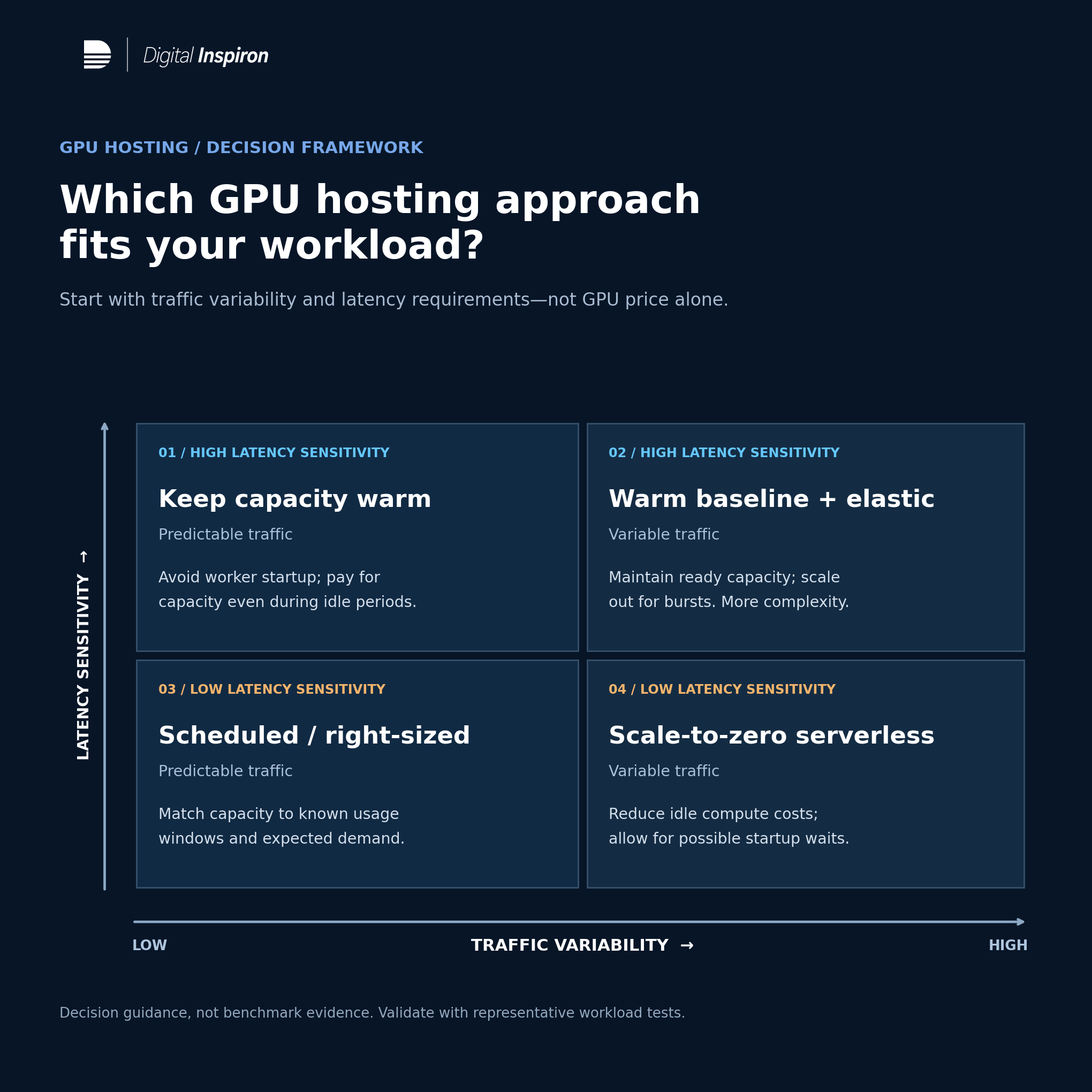
A practical evaluation can compare three configurations using the same model and representative requests:
- Scale-to-zero inference workers.
- Continuously available baseline capacity.
- Warm baseline capacity with elastic additional workers.
Test each configuration under cold, warm and concurrent conditions.
Compare median response time with tail latency, such as p95 and p99, where sample sizes support meaningful estimates.
Record cold-start frequency, time to first token, total response time, timeout rates and error rates.
An acceptable average can conceal occasional delays that matter to customers.
For streaming language-model applications, time to first token helps explain when a response begins. It should not be confused with the total time required to complete the response.
Measure infrastructure cost over a representative period, including idle time, startup behavior and any supporting services.
Then compare those results with the experience the product is expected to deliver.
There is no universal GPU utilization threshold that makes one hosting approach the correct choice for every application.
Choose the infrastructure that fits the experience
Lower infrastructure spending is valuable.
So is a responsive application.
The mistake is evaluating either objective in isolation.
For some workloads, allowing GPU workers to shut down is a practical way to control costs.
For others, keeping inference capacity available is part of delivering the expected experience.
Some applications will benefit from evaluating a position between those approaches.
The strongest decision begins with the workflow, measures real demand and identifies the response time users actually need.
Choose AI infrastructure based on the experience your application promises, not GPU price alone.
Technical References & Further Reading
The following official documentation provides additional technical guidance on GPU inference hosting, worker availability, scaling behavior, and performance optimization.
-
Runpod — Serverless Documentation
Explains serverless GPU inference, worker configurations, and how infrastructure scales with application demand. -
Modal — Scaling Documentation
Covers container autoscaling, minimum warm capacity, and configuration options for managing application responsiveness and resource utilization. -
Google Cloud — Vertex AI Generative AI Documentation
Provides guidance on deploying and optimizing generative AI workloads, including performance and latency considerations.
These resources offer technical context for the hosting approaches discussed in this article. Actual costs, startup delays, and response times depend on the provider, deployment configuration, model, and workload.